
Chemical Documentation Guide — SDS, CoA, TDS: What Each Document Means and Why It Matters

When you buy an industrial chemical, you receive more than the product. You receive a set of documents that define what the product is, how to handle it safely, and whether it meets the specification you ordered. These documents are not administrative paperwork — they are the primary means by which a chemical supplier demonstrates product quality, and the primary means by which your own quality system, safety team, and regulatory function can verify what arrived.
This guide explains what each document contains, what to check when you receive it, and what its absence or inadequacy signals about your supplier. Chemical Documentation Guide
Safety Data Sheet (SDS)
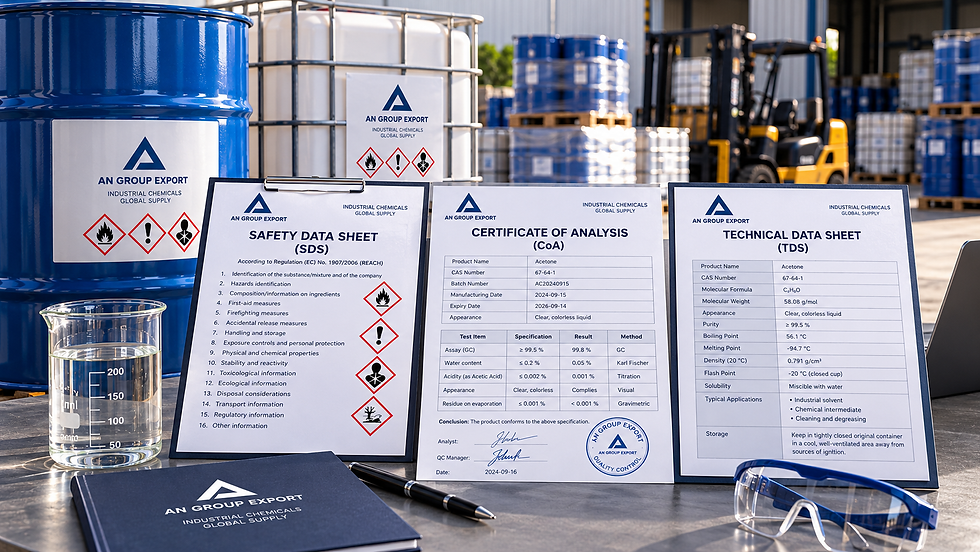
The SDS — formerly known as MSDS (Material Safety Data Sheet) — is a standardized document covering the hazard and safety profile of a chemical product. In the EU, SDS documents must comply with Regulation EC 1907/2006 (REACH) and follow a defined 16-section format. In the US, the equivalent format is governed by OSHA's Hazard Communication Standard. Most internationally traded chemicals use a format compatible with both.
The 16 sections cover identification, hazard identification, composition, first-aid measures, firefighting measures, accidental release measures, handling and storage, exposure controls and personal protection, physical and chemical properties, stability and reactivity, toxicological information, ecological information, disposal considerations, transport information, regulatory information, and other information.
What to check: the SDS should be specific to the product's concentration and grade — not a generic document that covers all concentrations of a chemical regardless of the specific hazard profile at the concentration you are receiving. A 98% sulfuric acid SDS and a 10% sulfuric acid SDS have meaningfully different hazard profiles. The document should show a revision date and the name of the company that prepared it. An SDS with no revision date, no company identification, or that clearly covers a different concentration from the product ordered is inadequate.
Certificate of Analysis (CoA)
The CoA is a document issued by the manufacturer — not the trading company — confirming the analytical results for a specific batch of product. It shows the actual measured values for the product's key quality parameters alongside the specification limits, allowing you to verify that the batch meets the grade and specification you ordered.
What a CoA should include: batch or lot number, production date, expiry date or retest date, the analytical method used for each test, the specification limit for each parameter, and the actual result measured for that specific batch. For a simple commodity chemical, this might cover assay (purity percentage), appearance, and one or two physical parameters. For a pharmaceutical-grade material, it will cover assay, identified impurities and their individual limits, residual solvents, heavy metals, and pharmacopeia-specific tests.
What to check: the CoA should reference the specific batch you received — the batch number on the CoA should match the batch number on the product label and packaging. A CoA without a batch number, or with a batch number that does not match your delivery, is not a CoA for your product — it is a generic document. The issuing entity should be the manufacturer, not the trading company — a CoA issued by a trading company on their own letterhead without reference to the manufacturing source cannot be verified against an original. For pharmaceutical, food-grade, or other regulated applications, the CoA should include a statement of conformance to the applicable standard (USP, BP, EP, food additive specifications).
Technical Data Sheet (TDS)
The TDS is a product-specific document covering technical and performance characteristics that go beyond basic safety and analytical data. Unlike the SDS (safety-focused) and CoA (batch-specific quality), the TDS provides application guidance — typical physical properties, recommended storage and handling, and performance data relevant to the product's intended use.
What a TDS typically includes: chemical name and synonyms, CAS number, molecular formula and weight, appearance and physical state, typical purity and grade, key physical properties (boiling point, melting point, flash point, density, viscosity, refractive index, solubility), storage recommendations, and sometimes application notes for the primary uses of the product.
What to check: a TDS is a reference document for the product type rather than a batch-specific document — it does not replace the CoA for quality verification but supplements it with typical property data useful for process and formulation work. Its absence does not necessarily indicate a problem, but its presence from a supplier who cannot provide the other documents does not compensate for missing SDS or CoA.
Other documentation you may need depending on your product and application
IFRA Conformity Statement — for fragrance ingredients, confirming compliance with IFRA maximum usage limits by product category. Allergen Declaration — for fragrance ingredients that are EU-listed allergens under Cosmetics Regulation 1223/2009. Natural Origin Declaration — for food and fragrance ingredients where natural origin designation affects labeling. Dangerous Goods Declaration — for products classified as dangerous goods under UN/ADR/IMDG/IATA regulations, required for every dangerous goods shipment. Certificate of Origin — confirming the country of manufacture, required by some buyers for customs or duty purposes. Export Authorization Documentation — for regulated or controlled products subject to export controls.
Documentation quality is the most reliable proxy for supplier quality in the chemical trading business. A supplier who provides complete, accurate, batch-specific documentation from the manufacturing source has a supply chain they can stand behind. A supplier whose documentation is generic, inconsistent, or issued by the trading company rather than the manufacturer has something to hide or something they do not know.
UAB An Group Export provides SDS, CoA, and TDS for every product as standard. Batch-specific manufacturer CoA, dangerous goods declarations, and product-specific compliance documentation are provided with every order.
Request documentation samples before ordering at info@angroupexport.com.


Comments