
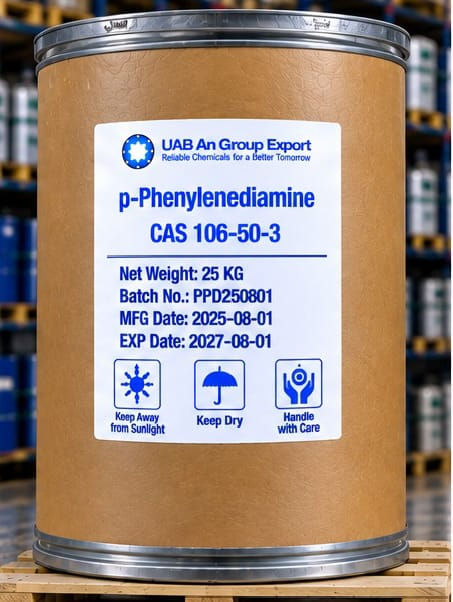

p-Phenylenediamine — CAS 106-50-3
p-Phenylenediamine — CAS 106-50-3
p-Phenylenediamine (PPD, CAS 106-50-3) is a primary aromatic diamine and a core raw material across dye manufacturing, polymer chemistry, rubber processing, and specialty chemical synthesis. UAB An Group Export supplies it in technical and industrial grades, matched to each customer's synthesis and manufacturing requirements.
It is used across oxidative hair dye manufacturing, azo and disperse dye production, aramid fiber manufacturing, rubber antiozonant synthesis, and pharmaceutical and agrochemical intermediate production. Its bifunctional primary amine structure makes it a highly reactive building block for a wide range of condensation, coupling, and polymerization reactions across industrial chemistry.
For qualified industrial buyers, supply is coordinated around grade, purity, volume, packaging, and delivery destination, in line with applicable product, handling, and regulatory requirements. Bulk and commercial orders are both handled — send your requirements and we'll prepare a quote covering supply, packaging, logistics, and delivery.
Regulatory Notice — Cosmetic Applications
p-Phenylenediamine is listed in Annex III of EU Cosmetics Regulation 1223/2009 as a restricted substance for use in oxidative hair dye products. Permitted maximum concentrations, mandatory warning labeling, and specific contraindications (including prohibition of use on broken or irritated skin and for eyebrow or eyelash dyeing) apply to finished cosmetic products containing PPD in regulated markets. PPD is one of the most documented contact sensitizers in commercial use — buyers formulating finished cosmetic or personal care products are responsible for ensuring full compliance with applicable cosmetic regulations, safety assessment requirements, and labeling obligations in their market. PPD is a primary aromatic amine — refer to the SDS for full handling, PPE, and exposure control requirements.
Key Applications
Oxidative Hair Dye ManufacturingThe primary oxidative dye precursor in permanent hair color formulations globally — PPD undergoes oxidative coupling with couplers in the presence of hydrogen peroxide to produce the final hair color. Subject to Annex III restrictions and mandatory warning labeling requirements in finished products sold in the EU and most regulated markets.
Aramid Fiber ManufacturingA core monomer in the production of para-aramid fibers (including Kevlar and Twaron-type materials) via condensation polymerization with terephthaloyl chloride — one of the highest-volume industrial applications of PPD globally.
Azo & Disperse Dye ManufacturingUsed as a diazotizable amine and coupling component in the synthesis of azo dyes, disperse dyes, and related colorant structures for textile, leather, and industrial applications.
Rubber Processing ChemicalsUsed as a raw material in the synthesis of para-phenylenediamine antiozonants (6PPD, IPPD, DPPD) widely used in tire and rubber product manufacturing to prevent ozone-induced cracking.
Pharmaceutical & Agrochemical IntermediatesUsed as a building block in the synthesis of select pharmaceutical active ingredients and agrochemical intermediates requiring a para-phenylenediamine scaffold.
Polymer & Specialty Chemical ManufacturingUsed in the production of polyimides, polybenzimidazoles, and other high-performance polymer systems requiring bifunctional amine monomers.
Supply & Packaging
Supplied according to your required grade and purity, quantity, packaging, and destination. p-Phenylenediamine is a white to light purple crystalline solid at room temperature — it darkens rapidly on exposure to air, light, and moisture due to oxidative degradation, which is characteristic of this compound and does not necessarily indicate quality compromise, though color should be specified in your CoA requirements. As a toxic solid (UN 1673, Class 6.1, PG III) and potent skin sensitizer, packaging, transport, and handling are arranged according to applicable dangerous-goods requirements, typically in sealed, moisture-proof drums or bags with appropriate hazmat labeling and documentation.
Storage must be in sealed, inert containers under nitrogen blanket where possible, away from heat, light, moisture, and oxidizing agents. Skin contact must be strictly avoided — PPD is a potent contact sensitizer and repeated dermal exposure can induce sensitization. Appropriate PPE including chemical-resistant gloves, eye protection, and respiratory protection is mandatory during all handling operations.
Product Documentation
Available on request, depending on the specific product and supply arrangement:
Safety Data Sheet (SDS), including sensitization and aromatic amine handling information
Certificate of Analysis (CoA), including color specification and purity
Technical Data Sheet (TDS)
Product specifications
Dangerous goods declaration
Shipping and transport documentation
Compliance statement:
"Due to the regulated nature of this product in cosmetic applications and its classification as a potent contact sensitizer, orders are subject to business registration verification and end-use declaration prior to confirmation. Buyers are responsible for verifying that the intended end use and market application comply with all applicable regulations including EU Cosmetics Regulation Annex III restrictions for cosmetic applications, applicable dangerous-goods handling requirements, and occupational health and safety obligations in their jurisdiction. UAB An Group Export reserves the right to request additional end-use declarations or supporting documentation and to decline any order where end use, destination, or buyer information cannot be adequately confirmed."
Request a Quote
Whether you need p-phenylenediamine for dye manufacturing, aramid fiber production, rubber processing chemicals, pharmaceutical intermediates, or another qualified industrial purpose, provide your requirements and our team will review the available supply options.
For a quotation, please provide: company name and registration → end-use application and downstream product → required grade and purity → quantity → packaging → delivery country/city or port → required delivery timeframe